


Many internship programs fall short of their potential. Managers eagerly welcome extra hands, interns arrive with enthusiasm, but then… ad-hoc tasks, inconsistent mentoring, and vague outcomes take over. The result? Mixed productivity, thin learning, and a weak conversion to full-time hires.
This playbook shows you how to design and run an intern program that not only works but also has the potential to create a reliable pipeline of future hires. With clear learning outcomes, real project throughput, measurable ROI, and a reliable pipeline of future hires, this program can be a game-changer for your organization. If you follow this step-by-step, you can plan in 3–4 weeks, run an 8–12 week cohort, and convert your best interns to high-performing employees.
1) The first step to a successful intern program is to start with the end in mind: define success before you even begin recruiting. Every effective program starts with a crisp definition of success.
Outcomes to lock in (one page max):
- Business goals: What should the cohort accomplish (e.g., ship 3 UX audits, prototype two features, clear 100 support tickets, publish 12 SEO pieces)?
- Talent goals: What skills will interns develop? What’s your intern-to-offer target and offer-accept goal?
- Manager outcomes: Fewer firefights, documented processes, reusable onboarding—quantify expected time saved.
Write this as an Intern Program Scorecard. It becomes your north star for recruiting, mentoring, and evaluation.
2) Program model & structure: pick the format that fits your org
Cohort vs. ad-hoc: Cohorts (all interns start together) create shared onboarding, rituals, and peer learning. Ad-hoc interns can work when you have rolling needs, but you must still give them structure.
Duration: 8–12 weeks is the sweet spot for meaningful projects and evaluation. Align to academic calendars where relevant.
In-office, hybrid, or remote:
- In-office: Easier mentoring, organic exposure.
- Hybrid/remote: Requires deliberate rituals (see Section 9).
- Choose based on the real working model of the team they’ll join.
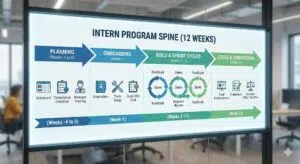
Program spine (the simple calendar):
- Week 0: Manager training + project scoping done.
- Week 1: Orientation, tools, first “quick win.”
- Weeks 2–7/9: Sprint cycles with demos and midpoint reviews.
- Final week: Presentations, evaluations, conversion decisions.
3) Role design: high-value projects, not busywork
Interns do best on scoped, valuable, time-boxed work—not random tickets.
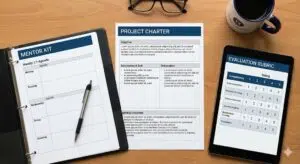
Design each project with this one-pager (Project Charter):
- Objective: What problem and why it matters.
- Deliverables & definition of done: Artifacts, acceptance criteria, due dates.
- Learning outcomes: Skills/competencies the intern will practice.
- Guardrails: Data sets, Access, constraints, compliance notes.
- Stakeholders & reviewer: Who approves, who unblocks.
- Timeline: Milestones by week.
If a task can’t be written into a charter, it’s probably not internship-appropriate.
4) Compliance & pay: get this right upfront
Be explicit and conservative. Private-sector unpaid internships are narrow exceptions and risky; pay your interns unless your counsel confirms a lawful, limited exception. Put the compensation range and employment status in the posting, document learning objectives, ensure supervision, and keep evaluation records. Add a brief compliance checklist to your kickoff (role scope, supervision plan, evaluations, documentation trail). When in doubt, consult counsel—before you publish the roles.
5) Recruiting that converts: clarity attracts, structure selects
Write the posting like a micro-brief:
- The real problems to solve.
- Tools/tech/context (no buzzword soup).
- Clear learning outcomes.
- Program length, schedule, pay, location/remote policy.
- Selection stages and timeline.
Sourcing mix: Campus career centers, targeted job boards, professional communities, and inclusive student organizations. For design/engineering/analytics, invite portfolios or minor artifacts (links, repos, case write-ups).
Selection flow (lightweight but predictive):
- Resume/portfolio screen against your scorecard.
- 20-minute structured screen: Same questions, rubric-scored.
- 2–3 hour work sample: A scaled-down real task; graded blind with a rubric.
- Structured interview: Behavioral + situational prompts mapped to competencies.
- Decision huddle: Evidence first, impressions last. Record reasons.
This flow is fair, fast, and highly predictive without overburdening candidates.
6) Onboarding that actually onboards
The first 5 days make or break momentum.
Day-1 checklist (no exceptions):
- Accounts, permissions, and tools are set up before arrival.
- Program overview: goals, calendar, rituals, expectations.
- Team intros: who does what, how to ask for help.
- “Quick win” task: something shippable in 24–48 hours.
Week-1 playbook:
- Product/brand walkthroughs, data access rules, coding/design standards.
- Buddy assignment (non-manager) + mentor (manager or senior IC).
- First project kickoff using the Project Charter.
7) Mentoring & management: enable
Managers rarely fail for lack of goodwill—they fail for lack of structure. Give them an enablement kit:
Mentor kit (one page each):
- Weekly 1:1 agenda: Progress, blockers, feedback, following sprint goals.
- Feedback guide: Specific, behavior-based, with examples and next steps.
- Scope control tips: How to cut scope without cutting learning.
- Quality bar: Links to coding/design/content standards and examples.
Cadence:
- Weekly 1:1s (30 min), daily async updates (Slack/Notion/Jira), mid-point review (Week 4–6), final demo.
- Encourage mentors to narrate decisions (“why we’re doing X, not Y”)—that’s where most learning happens.
8) Evaluation & conversion: decide with evidence, not vibes
Build a three-part evaluation mapped to your scorecard:
- Competency rubric (1–5): Communication, execution, problem-solving, collaboration, role-specific skills (e.g., SQL, Figma, Python, copywriting). Use behavioral anchors.
- Project outcomes: Did deliverables hit the Definition of Done? Include quality checks.
- Professional readiness: Reliability, feedback handling, and autonomy growth.
Conversion decisions (final week):
- If yes: share a clear conversion path (target team, level, comp band, timeline).
- If “not yet”: document gaps and offer a re-apply path (or a short contractor stint with milestone goals).
- If no: end with dignity—share strengths, development areas, and resources.
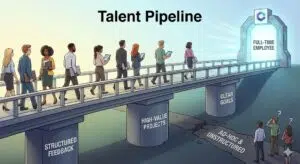
Track intern-to-offer and offer-accept rates; your goal is a reliable funnel of future hires, not a one-off.
9) Remote & hybrid programs that don’t disappear
Remote interns fail when they’re invisible—design visibility.
Rituals that work:
- Weekly sprint demos: 30–45 minutes, all interns present progress; record for async viewing.
- Written weekly updates: Template with “what I shipped / what I learned / what’s next / blockers.”
- Buddy system: One buddy per intern for daily questions; mentor for bigger decisions.
- Office hours: Standing Q&A slot with program lead.
Tooling: Shared docs (Notion/Confluence), task tracking (Jira/Asana), version control (Git), and agreed Slack/Meet norms (response times, status, channels).
10) Measurement & ROI: if you don’t measure it, you’ll guess
Track outcomes, experience, and process health:
Outcomes
- Business impact: shipped artifacts, tickets closed, prototypes validated, SEO pieces published, and adoption metrics.
- Talent impact: intern-to-offer %, offer-accept %, 90-day performance of conversions vs. non-intern hires.
Experience
- Intern NPS, mentor NPS, learning-outcome self-ratings, “would you return?” and “would you recommend us?”
Process health
- Time-to-productivity (days to first meaningful contribution).
- Pass-through rates at each selection stage.
- Manager time invested vs. saved (qualitative & rough hours).
Review this in a post-mortem within two weeks of program end. Keep what worked, fix what didn’t, and document for next cycle.
11) Common pitfalls—and how to avoid them fast
- Vague scopes → busywork
- Fix: Use Project Charters with Definition of Done. Pre-approve data and Access.
- Mentor overload → slow progress
- Fix: Weekly 1:1s + daily async updates + buddy system. Provide ready-to-use templates.
- Unstructured selection → weak signal
- Fix: Structured screens, small work sample, anchored rubrics, decision huddles.
- Compliance as an afterthought
- Fix: Decide pay/status before posting; document learning outcomes; ensure supervision and evaluations; consult counsel.
- Last-minute conversion
- Fix: Set conversion bar and timelines at kickoff; run mid-point calibration; pre-plan conversion headcount.
12) Your plug-and-play toolkit (copy, paste, and adapt)
A) Intern Program Scorecard (excerpt)
- Program goals: Ship 2 prototypes; publish 10 SEO articles; cut backlog by 15%.
- Talent goals: 50–70% intern-to-offer; 80% offer-accept; 90-day success ≥ target.
- Competencies: Communication, execution, problem-solving, collaboration, role-specific skill(s).
- Rituals: Weekly demo, weekly 1:1, midpoint review, final presentation.
B) Project Charter (template)
Objective: [Problem + why it matters]
Deliverables & DoD: [Artifacts + acceptance criteria + due dates]
Learning outcomes: [Skills/competencies]
Constraints: [Access, data, tools, compliance notes]
Stakeholders: [Approver + unblockers]
Timeline: [Milestones by week]
C) Weekly 1:1 Agenda (copy-ready)
- Progress since last week (link artifacts)
- Blockers & asks
- Feedback (manager → intern, intern → manager)
- Next week’s goals (measurable)
- Risks/adjustments
D) Evaluation Rubric (1–5 anchors)
1: Vague, incomplete, needs continual direction
3: Clear examples, meet quality bar with minor corrections
5: Independent, high-quality outputs, anticipates risks, communicates trade-offs
E) Midpoint Review Script
- What’s shipped? What’s next?
- What will we cut to land the outcomes?
- Where does the intern need coaching or resources?
- Conversion trajectory: on track/needs stretch / unlikely this cycle
F) Final Presentation Outline (8–12 slides)
- Problem, constraints, approach
- Demos/artifacts
- Results, impact, lessons learned
- What I’d do next with more time
13) Timeline: 90-day blueprint at a glance
Weeks −4 to −2 (Planning): Scorecard, compliance check, manager training, project scoping, postings live.
Weeks −2 to 0 (Selection): Screen, work samples, structured interviews, offers out, cohort logistics.
Week 1 (Onboarding): Orientation, quick wins, buddy/mentor cadence.
Weeks 2–7/9 (Build): Sprint cycles, demos, midpoint review, scope control.
Final week (Close): Presentations, evaluations, conversion decisions, offers.
+2 weeks (Retro): Post-mortem, metrics, and docs updated for next cycle.
