

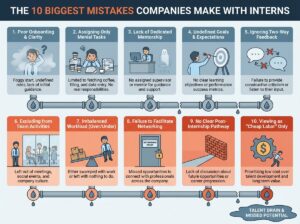
A lot of companies say they want fresh ideas, future talent, and a stronger hiring pipeline.
Then they bring in interns… and completely waste the opportunity.
Honestly, it happens all the time. A smart, motivated person shows up ready to learn, help, and prove themselves. And instead of being developed, they get ignored, underused, overworked, or treated like a temporary inconvenience. Then the company wonders why the internship “didn’t really lead anywhere.”
That’s the part that gets me.
Because a good internship program isn’t just a nice thing to offer. It’s one of the easiest ways to build loyalty, train future hires, and bring new energy into a team. But only if companies stop making the same mistakes over and over again.
Let’s get into the big ones.
1. Treating interns like free labor
This is probably the most common mistake. And the most damaging.
Some companies bring interns in with one goal: get as much low-level work out of them as possible. Endless data entry. Coffee runs. Random admin tasks nobody else wants to touch. And sure, every job has boring parts. That’s real life.
But when an intern’s entire experience is built around busywork, they’re not learning. They’re just filling gaps.
Here’s the bigger issue: talented interns know when they’re being used. They may smile, do the work, and stay polite, but they leave with a very clear impression of your company. And it’s usually not a good one.
Interns should contribute, yes. But contribution without learning is just exploitation with a nicer label.
2. Giving them no real structure
A lot of internships feel thrown together at the last minute.
Someone says, “Oh right, the intern starts Monday,” and then there’s a scramble to find them a desk, create a login, and figure out who’s supposed to talk to them. From there, the whole experience becomes reactive. No plan. No milestones. No clear ownership.
That kind of chaos makes interns feel like an afterthought.
And look, people can’t succeed in an environment where nobody has defined what success even looks like. They need to know what they’re working on, why it matters, who they report to, and what they’re supposed to learn by the end.
Without structure, even the best intern starts drifting.
3. Forgetting that interns are there to learn
This sounds obvious, but companies miss it constantly.
An internship is not just a cheaper version of a junior employee role. It’s a training experience. That means teaching is part of the job. Explaining context matters. Giving feedback matters. Answering questions matters.
But some managers act like interns should magically know everything already. They toss over assignments, disappear into meetings, and get annoyed when the intern needs help.
That’s backwards.
The whole point is that they don’t know everything yet. They’re there to build confidence, judgment, and skill. If nobody is investing in that, the company is failing the internship, not the other way around.
4. Assigning work with zero context
This one quietly ruins a lot of otherwise decent internships.
An intern gets a task like “update this spreadsheet,” “research competitors,” or “draft a social post.” But nobody explains how the task connects to the team, the client, or the business.
So they do the work… kind of blindly.
And that’s frustrating, because context is what makes work meaningful. It’s also what helps someone do a better job. When interns understand the bigger picture, they make smarter decisions. They ask better questions. They start thinking like actual team members instead of task machines.
People care more when they know why something matters. That’s true at every level.
5. Not giving feedback until it’s too late
You know that awkward moment when someone’s been doing something wrong for three weeks, and nobody says anything until the end?
Yeah. Companies do that to interns all the time.
They stay quiet because they want to be nice. Or they’re too busy. Or they assume someone else will handle it. Then the internship wraps up and suddenly the intern hears vague comments like, “You could’ve been more proactive,” or “Your communication needed work.”
That’s not feedback. That’s a missed opportunity.
Feedback only helps when it comes early enough to use. Interns need small course corrections in real time. What they’re doing well. Where they need to improve. What “better” actually looks like.
And it doesn’t need to be harsh. Just clear. Honest. Regular.
6. Leaving them isolated
Interns can feel weirdly invisible in a company.
They’re not quite part of the team yet. They don’t know the inside jokes. They’re usually the youngest person in the room. Sometimes they’re too intimidated to speak up, and nobody makes the effort to pull them in.
That isolation adds up fast.
A bad internship isn’t always bad because of the work. Sometimes it’s bad because nobody talked to the intern unless they needed something. No welcome. No check-ins. No introductions. No feeling of belonging.
And that matters more than companies think.
When interns feel included, they engage more. They contribute more. They remember the experience more positively. A little attention goes a long way here. Introduce them properly. Invite them to meetings when it makes sense. Ask what they think. Make space for them.
Nobody does their best work when they feel like they’re in the way.
7. Expecting professional confidence from someone brand new
This one is subtle, but it shows up everywhere.
Managers say they want interns to “take initiative,” “speak up more,” or “own their work.” Fair enough. Those are good qualities. But sometimes what they really mean is: act like you’ve done this before.
And the intern hasn’t.
They may be smart, capable, and eager, but they’re still learning how to operate in a workplace. Things that feel obvious to experienced employees—how to write a status update, when to ask questions, how to join a meeting without sounding nervous—can feel incredibly high stakes to someone just starting out.
Confidence usually comes after support, not before it.
If companies want interns to step up, they need to create an environment where stepping up feels safe.
8. Failing to assign one person who actually owns the experience
When everyone is “kind of” responsible for the intern, nobody really is.
That’s when things slip. Questions go unanswered. Projects stall. Feedback gets inconsistent. The intern ends up bouncing between people, trying not to bother anyone, while quietly getting lost.
Every intern needs one clear point of contact. A manager, mentor, coordinator—someone who knows what they’re working on, checks in regularly, and makes sure the experience is moving in the right direction.
It doesn’t have to be complicated. But it does have to be intentional.
Because from the intern’s side, uncertainty feels huge. Even simple things—“Who do I ask?” “Am I doing okay?” “What should I focus on today?”—can become stressful when there’s no clear anchor.
9. Ignoring their perspective
Here’s the irony: companies often say they want interns because they bring fresh thinking. Then they never actually listen to them.
Interns notice things. A lot of things.
They notice confusing processes, outdated tools, clunky communication, weak onboarding, and ideas the team stopped questioning years ago. They see the company with fresh eyes, which is incredibly valuable. But too often, nobody asks what they’re seeing.
That’s a waste.
No, interns won’t always have the perfect answer. But they often have useful observations, especially about customer experience, content, digital habits, and team culture. Sometimes the newest person in the room can spot the most obvious problem because they haven’t learned to ignore it yet.
Companies that dismiss intern input are throwing away one of the biggest benefits of having interns in the first place.
10. Ending the internship with no closure, no recognition, and no next step
This is such a bad look, and it happens constantly.
The internship ends. Maybe there’s a quick goodbye. Maybe not. No formal wrap-up. No thoughtful feedback. No conversation about what the intern accomplished. No guidance on future roles. Sometimes not even a proper thank-you.
After weeks or months of work, that kind of ending feels cold.
People remember endings. They remember whether their effort was seen. Whether someone took five minutes to say, “Here’s what you did well, here’s what you’ve grown in, and here’s where you could go next.”
Not every internship needs to turn into a job offer. But every internship should end with respect, clarity, and acknowledgment.
That’s basic professionalism. And honestly, basic decency too.
Why this matters more than companies think
A lot of leaders treat internships like a small side program. Something temporary. Something low-stakes.
But it’s not low-stakes to the person living it.
For the intern, this might be their first real look at working life. Their first big confidence test. Their first chance to imagine who they could become in a career. A great internship can light someone up. A bad one can make them question whether they belong at all.
And from the company side? Internships shape reputation. They influence future hiring. They affect employer brand, word of mouth, and long-term talent pipelines.
In other words, how you treat interns says a lot about how you treat people. Period.
What good companies do instead
The companies that get internships right usually keep things pretty simple.
They prepare before day one. They give interns meaningful work. They explain the why behind the task. They check in. They teach. They offer feedback while there’s still time to improve. They make interns feel included, not peripheral. And when the internship ends, they close the loop with care.
That’s it.
Not flashy. Not complicated. Just thoughtful.
And that thoughtfulness pays off. Because when interns feel supported, they don’t just do better work. They become future hires, advocates, referrals, and people who remember your company for the right reasons.
That’s worth a lot more than a few months of cheap labor.
If you want, I can also turn this into a more SEO-friendly blog post with a stronger headline, meta description, and intro hook.